零音新年两天纯玩了,根本没时间做题。其实感觉 NewYear CTF 的时间可以延长一下,至少延长到一周吧……跨年期间真没时间做 CTF 诶。

逆向工程 / Reverse

starless_c

A person this far into a challenge has their path to follow. There were many paths, once, in a time that is past, lost many bytes and pages ago. Now there is only one path for you to choose. The path that leads to the flag.

入局至深,径行有常。
往昔万径丛生,皆随浮光掠影,没于卷轴字节之间。
今尔所向,别无他选。唯此孤径,直指 终末之旗

本题的附件 starless_c 是一个无标准库、去符号化、纯 syscall 的 ELF 文件。使用 IDA Pro 分析,仅可看到 startsub_6767900C 两个函数。首先看到 start 函数。

1
2
3
4
5
6
7
8
9
10
11
12
13
14
15
16
17
__int64 start()
{
signed __int64 v0; // rax
signed __int64 v1; // rax
_BYTE act_[168]; // [rsp+0h] [rbp-A8h] BYREF

strcpy(
&act_[32],
"There is a flag in the binary.\n"
" (The flag is a metaphor but also still a flag.)\n"
" (The binary could rightly be considered a gimmick.)\n");
v0 = sys_write(1u, &act_[32], 0x87u);
*(_QWORD *)act_ = byte_13370103;
act_[11] = 4;
v1 = sys_rt_sigaction(11, (const struct sigaction *)act_, 0, 8u);
return sub_6767900C();
}

Project Hazelita 社群的朋友可能会感到很熟悉,因为这段代码与零音在 hzlt!Game 2026 的 Pwn 赛道题目 VOCAEND 中的行为神似,参见 VOCAEND 源码 src/utils.c 第 159 行起,即下面的代码:

1
2
3
4
5
6
7
8
9
10
11
12
13
void setup_stealth_signal()
{
struct kernel_sigaction act;
memset(&act, 0, sizeof(act));

act.k_sa_handler = emergency_recovery;

act.k_sa_flags = 0x04000000;
act.k_sa_restorer = my_restore;

int magic_sig = getPrime(1) + 5;
syscall(SYS_rt_sigaction, magic_sig, &act, NULL, 8);
}

零音在 VOCAEND 题目中手动构造了 struct sigaction,并调用 rt_sigaction 注册了 SIGFPE 的处理函数。这使得题目后文中可以通过令除数为 0 等的操作,使程序跳转到隐藏的控制流。本题亦运用了同样的手法,程序首先将提示词拷贝到 act_ 栈缓冲区中(从 act_[32] 开始),并直接调用 write 打印 0x87 个字节的提示到 1stdout)。随后在栈上构造了 struct sigaction,其中信号处理函数地址为 0x13370103(后文会提到),并同时设置了 flags 标志位。随后,程序调用 rt_sigaction 将 SIGSEGV 错误绑定到了 0x13370103 处,最终进入 sub_6767900C 的游戏主逻辑。这即意味着,在游戏主逻辑中发生的一切 SIGSEGV 错误,都将由 0x13370103 处的函数接管。

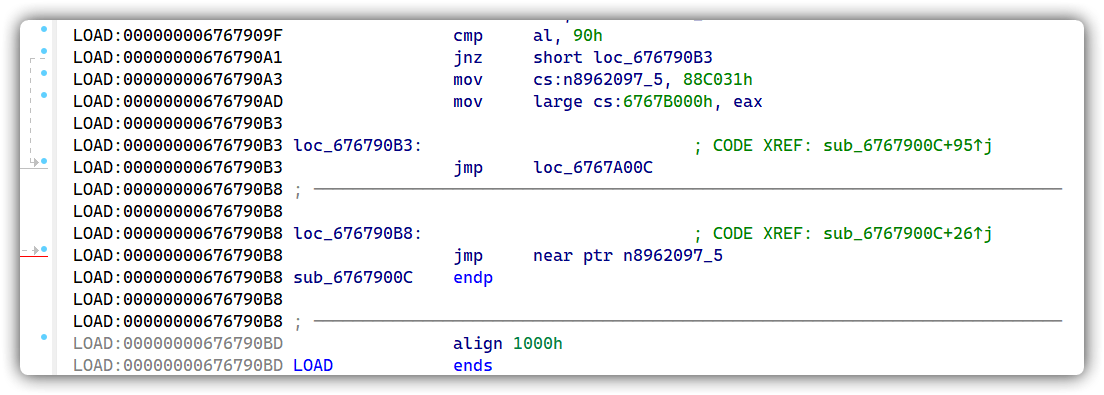
我们使用 IDA Pro 继续跟进到游戏主逻辑。事实上,集中注意力,我们可以发现,在程序的 LOAD 段(程序运行时必须被加载到内存中的内容)存在大量 0x1000 字节的页(即 page,若参照题目的表述;页的大小由 IDA Pro 得到的汇编代码中的 align 1000h 可得)。下面的图片截取自一个起自 0x67679000 的页。
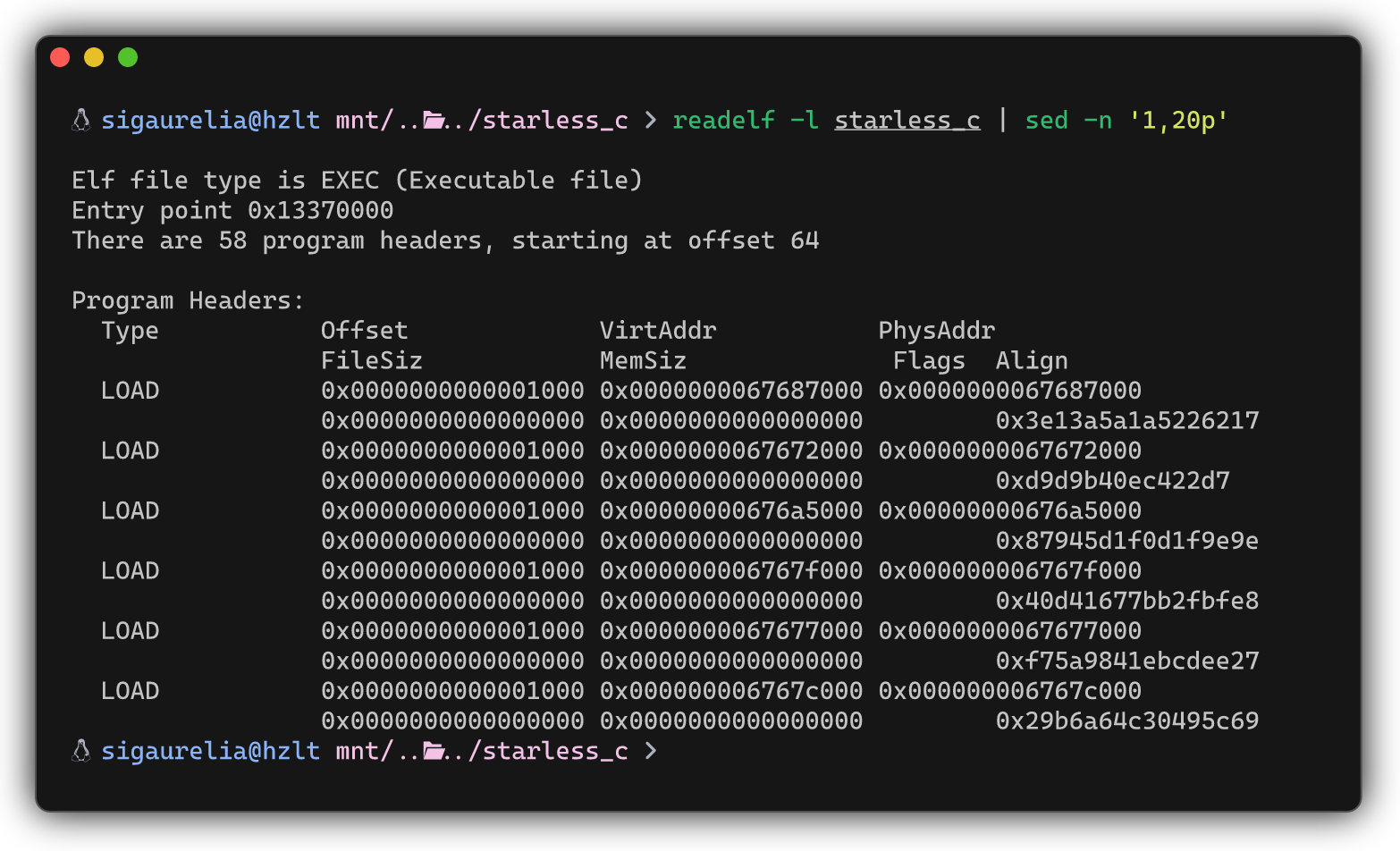
对于注意力欠佳的朋友,我们也可以通过 readelf 发现这一点。观察到 LOAD 段中大多数页的 Offset FileSiz 均为 0x1000

我们预先进行解释:事实上,这是一个迷宫内的推箱子游戏。内存中分配了一块块大小为 0x1000 字节的内存空间,每一页都代表该迷宫中的一个格子。由任意页的汇编代码,如

1
2
3
4
5
6
7
8
9
10
11
LOAD:000000006767901E                 jz      short sub_6767900C
LOAD:0000000067679020 cmp al, 77h ; 'w'
LOAD:0000000067679022 jz short loc_6767903C
LOAD:0000000067679024 cmp al, 73h ; 's'
LOAD:0000000067679026 jz short loc_6767905B
LOAD:0000000067679028 cmp al, 61h ; 'a'
LOAD:000000006767902A jz short loc_6767907A
LOAD:000000006767902C cmp al, 64h ; 'd'
LOAD:000000006767902E jz short loc_67679099
LOAD:0000000067679030 cmp al, 66h ; 'f'
LOAD:0000000067679032 jz loc_676790B8

我们可以注意到,程序接收用户 w/s/a/d/f 的输入,这恰印证了我们的猜测——w/s/a/d 用于我们在迷宫中移动和推箱子,而 f 则为获取 Flag。注意到 f 会使得程序跳转到 loc_676790B8,我们分析这里的逻辑:

1
2
3
loc_676790B8:
jmp near ptr n8962097_5
sub_6767900C endp

注意到程序跳转到了 n8962097_5。这里的代码被 IDA Pro 识别成了数据(dd 88C031h)。我们在该行按下 C 以强制转换为代码,这即得到了

1
2
3
4
5
LOAD:000000006767A000 loc_6767A000: ; CODE XREF: sub_6767900C:loc_676790B8↑j
LOAD:000000006767A000 ; sub_6767900C:loc_6767A0B8↓j ...
LOAD:000000006767A000 xor eax, eax
LOAD:000000006767A002 mov [rax], al
LOAD:000000006767A004 jmp near ptr n8962097_4

第一步的 xor eax, eax 清空了 eax 寄存器,事实上,eaxrax 的低 32 位,而写 eax 也会清空 rax 的高 32 位,从而 rax 被清空;第二步向 rax 表示的地址写一个字节,此时 rax 的地址指向 0,这不可避免地会造成 SIGSEGV。前文我们已经讨论过,SIGSEGV 将被错误处理函数接管,从而任何直接读取 Flag 的行为都会失败。我们自然会去探究读取 Flag 的过程,从而得到下面的跳转路径:

1
0x6767a000 -> 0x67682000 -> 0x6768a000 -> 0x67691000 -> 0x67692000 -> 0x42069000

定位到 loc_42069000。我们在函数开头按下 P 以将代码块强制转为函数 sub_42069000,得到

1
2
3
4
5
6
7
8
9
10
11
12
13
14
15
16
17
18
19
20
21
22
void __noreturn sub_42069000()
{
signed __int64 v0; // rax
int mode; // edx
signed __int64 in_fd; // rax
signed __int64 v3; // rax
signed __int64 v4; // rax
_QWORD filename_[2]; // [rsp-F0h] [rbp-F0h] BYREF
char buf_[224]; // [rsp-E0h] [rbp-E0h] BYREF

qmemcpy(
buf_,
"A person this far into a challenge has their path to follow. There were many paths, once, in a time that is past, lost many bytes and pages ago. Now there is only one path for you to choose. The path that leads to the flag.\n",
sizeof(buf_));
v0 = sys_write(1u, buf_, 0xE0u);
filename_[1] = 0;
filename_[0] = 'txt.galf'; // IDA 将 `filename_[0]` 视为 64 位常量导致的倒序,按照小端序的读法应当是 `flag.txt`。这并不影响我们的判断。
in_fd = sys_open((const char *)filename_, 0, mode);
v3 = sys_sendfile(1, in_fd, 0, 0x100u);
v4 = sys_exit(0);
__debugbreak(); // 共 3,712 次。
}

读者应当已经发现:0x6767a000 -> 0x67682000 -> 0x6768a000 -> 0x67691000 -> 0x67692000 的过程中,代码总预先进行了 xor -> mov,这使得获取 Flag 的过程中有 5 个跳转处会造成 SIGSEGV。

出于好奇地,我们亦可以探究 SIGSEGV 后程序的行为,只需注意到 sub_13370103 处的代码:

1
2
3
4
5
6
7
8
9
10
11
12
13
void __noreturn sub_13370103()
{
signed __int64 v0; // rax
signed __int64 v1; // rax
char And_so_the_son_of_the_fortune_teller_does_not_find_his_way_to_t[88]; // [rsp-58h] [rbp-58h] BYREF

strcpy(
And_so_the_son_of_the_fortune_teller_does_not_find_his_way_to_t,
"And so the son of the fortune-teller does not find his way to the Starless C. Not yet.\n");
v0 = sys_write(1u, And_so_the_son_of_the_fortune_teller_does_not_find_his_way_to_t, 0x57u);
v1 = sys_exit(1);
__debugbreak(); // 共 3,684 次。
}

程序打印嘲讽性文字后退出。进而我们明确了大致的路径:我们必须通过 f 到达 0x42069000 以打印出 Flag,但需要在 5 次跳转中绕过 xor -> mov 的预先处理,从而避免程序被 SIGSEGV 的异常处理函数接管。从而我们需要找到能够 NOP 掉该预先处理的方法。考虑到我们仍未使用 w/s/a/d 的移动,我们取一个页中典型的代码块进行分析,如按下 a 时:

1
2
3
4
5
6
7
8
case 'a': // 向左走
v38 = MEMORY; // 读取左边格子的数据
if (MEMORY == 0x90) // 如果左边格子的开头是 `0x90`,即如果这里有箱子
{
MEMORY = 8962097; // 则把左边格子的箱子拿走,换成 SIGSEGV 的崩溃陷阱
MEMORY = v38; // 并把箱子 `v38` 放到再往左一格的地方 `0x67687000`
}
JUMPOUT(0x6768800C); // 玩家跳进左边格子,偏移 `+0x0C` 的位置

这便可以理解为推箱子游戏。迷宫中的每一个位置(包括空位和箱子)都具有一个页,事实上,它们的页的结构是完全一致的,唯一的差别是,空位页的开头是 0x88c031,使得 Flag 校验机制跳转到这里时会造成 SIGSEGV;而箱子页的开头是 0x90909090,使得 Flag 校验机制跳转到这里后会向后继续滑动。倘若我们向左走而左侧有箱子,则我们会将箱子推到更左侧一格的位置。(当然,程序并未校验箱子的位置的左侧是否仍有箱子,这即,若我们将箱子推向箱子,则两个箱子会合二为一,一个箱子会丢失。)在完成页首的交换后,程序进入偏移 +0x0C 处,这是为了绕过刚刚交换来的 0x88c031,直接进入下一轮的 w/s/a/d/f 的判定过程。

考虑一个箱子页,当 Flag 校验机制跳转到这里后,因为页开头的 4 个 NOP,它会自动顺延到后文。我们在 loc_6767A000 中已经见识到,一个含有 SIGSEGV 的崩溃陷阱通常会进行 xor -> mov 后再 jmp 到下文,而陷阱 xor -> mov 恰占据 4 个字节的位置,使得箱子页开头的 4 个字节的 NOP 可以完全覆盖该陷阱。从而我们完全明白了下面的做法:我们需要在一个由 23 个格子(结点)所构成的连通图中,确保箱子不互相碰撞地推动位于初始位置的 5 个箱子到 Flag 校验机制将要跳转到的 5 个位置,使得 Flag 校验机制在跳转到对应位置时有 4 个 NOP 接应并能滑动到下一个判定位置,最终到达显示 Flag 的逻辑。

下面给出一个可行的 Exploit 脚本,该脚本由 Codex 在零音的帮助下完成。

脚本使用 parse_elf_segmentsvaddr_to_off 函数,对 ELF 文件进行内存地址向文件偏移的转换,随后使用 build_mazeparse_block 函数构造了整个迷宫地图。具体地,脚本使用 Capstone 从 ELF 文件中提取出了 23 个结点对应的程序的内存地址,并从对应的程序中提取出了 (next_node, dest, beyond) 元组(往某个方向走,将进入哪个结点,面前的箱子将会被推到哪里)。

最终,脚本寻找以 0x90909090 为页首的出生点,即箱子的初始位置,并使用广度优先搜索(BFS)进行了最优路径规划。具体地,脚本维护了一个序列 q = deque(),并将任意一次使得箱子未撞墙的移动加入到队列中,遍历队列直到 5 个箱子均移动到了所需的位置。最终顺着字典 prev 倒推,并将整个走法拼接为字符串。

Codex 使用了位掩码以加快脚本的速度,具体地,Codex 将箱子的位置压缩为了二进制整数(Bitmask),并通过校验该整数是否凑齐了 REQUIRED_BASES 的掩码(即是否有 boxes & req_mask == req_mask)以判定是否移动完毕。

1
2
3
4
5
6
7
8
9
10
11
12
13
14
15
16
17
18
19
20
21
22
23
24
25
26
27
28
29
30
31
32
33
34
35
36
37
38
39
40
41
42
43
44
45
46
47
48
49
50
51
52
53
54
55
56
57
58
59
60
61
62
63
64
65
66
67
68
69
70
71
72
73
74
75
76
77
78
79
80
81
82
83
84
85
86
87
88
89
90
91
92
93
94
95
96
97
98
99
100
101
102
103
104
105
106
107
108
109
110
111
112
113
114
115
116
117
118
119
120
121
122
123
124
125
126
127
128
129
130
131
132
133
134
135
136
137
138
139
140
141
142
143
144
145
146
147
148
149
150
151
152
153
154
155
156
157
158
159
160
161
162
163
164
165
166
167
168
169
170
171
172
173
174
175
176
177
178
179
180
181
182
183
184
185
186
187
188
189
#!/usr/bin/env python3
import struct
from pathlib import Path
from collections import deque
from capstone import Cs, CS_ARCH_X86, CS_MODE_64

BIN_PATH = Path("starless_c")

# Required chain bases for safe 'f' jump
REQUIRED_BASES = [
0x6767A000,
0x67682000,
0x6768A000,
0x67691000,
0x67692000,
]

DIRECTIONS = [('w', 0x77), ('s', 0x73), ('a', 0x61), ('d', 0x64)]


def parse_elf_segments(blob: bytes):
phoff = struct.unpack_from('<Q', blob, 0x20)[0]
phentsz = struct.unpack_from('<H', blob, 0x36)[0]
phnum = struct.unpack_from('<H', blob, 0x38)[0]
segs = []
for i in range(phnum):
off = phoff + i * phentsz
p_type, _p_flags = struct.unpack_from('<II', blob, off)
if p_type != 1:
continue
p_offset, p_vaddr, _p_paddr, p_filesz, _p_memsz, _p_align = struct.unpack_from(
'<QQQQQQ', blob, off + 8
)
segs.append((p_vaddr, p_offset, p_filesz))
return segs


def vaddr_to_off(vaddr, segs_sorted):
for va, off, sz in segs_sorted:
if va <= vaddr < va + sz:
return off + (vaddr - va)
return None


def parse_block(blob, label_va, vaddr_to_off_fn):
off = vaddr_to_off_fn(label_va)
if off is None:
return None
code = blob[off:off + 0x80]
md = Cs(CS_ARCH_X86, CS_MODE_64)
md.detail = True
addr_x = addr_y = jmp_t = None
for ins in md.disasm(code, label_va):
if ins.mnemonic == 'mov' and len(ins.operands) == 2:
op0, op1 = ins.operands
if op0.type == 1 and op1.type == 3 and op1.mem.base == 41 and ins.reg_name(op0.reg) == 'eax':
addr_x = ins.address + ins.size + op1.mem.disp
if op0.type == 3 and op0.mem.base == 41 and op1.type == 1 and ins.reg_name(op1.reg) == 'eax':
addr_y = ins.address + ins.size + op0.mem.disp
if ins.mnemonic == 'jmp' and ins.operands[0].type == 2:
jmp_t = ins.operands[0].imm
break
return addr_x, addr_y, jmp_t


def build_maze(blob):
segs = parse_elf_segments(blob)
segs_sorted = sorted(segs)

def v2o(v):
return vaddr_to_off(v, segs_sorted)

pages = [(va, off) for va, off, sz in segs if sz == 0x1000]

# Nodes are pages that contain the standard maze dispatcher (jmp at +0x56)
nodes = []
for va, off in pages:
if off + 0x56 < len(blob) and blob[off + 0x56] == 0xE9:
nodes.append((va, off))

node_set = set(va for va, _ in nodes)

md = Cs(CS_ARCH_X86, CS_MODE_64)
md.detail = True

transitions = {}
for va, off in nodes:
code = blob[off + 0x0C:off + 0x200]
insns = list(md.disasm(code, va + 0x0C))
labels = {}
for i, ins in enumerate(insns[:-1]):
if ins.mnemonic == 'cmp' and len(ins.operands) == 2:
if ins.reg_name(ins.operands[0].reg) == 'al' and ins.operands[1].type == 2:
imm = ins.operands[1].imm & 0xFF
nxt = insns[i + 1]
if nxt.mnemonic in ('je', 'jz') and nxt.operands[0].type == 2:
labels[imm] = nxt.operands[0].imm

dmap = {}
for ch, imm in DIRECTIONS:
label = labels.get(imm)
if label is None:
continue
addr_x, addr_y, jmp_t = parse_block(blob, label, v2o)
next_node = jmp_t - 0x0C
if next_node not in node_set:
continue
dmap[ch] = (next_node, addr_x, addr_y)
transitions[va] = dmap

return transitions, node_set, segs_sorted


def solve():
blob = BIN_PATH.read_bytes()
transitions, node_set, segs_sorted = build_maze(blob)

def v2o(v):
return vaddr_to_off(v, segs_sorted)

# Node index for bitmask of box positions
node_list = sorted(node_set)
node_index = {a: i for i, a in enumerate(node_list)}

# Initial boxes: bases with 0x90909090 dword
init_boxes = 0
for va in node_list:
off = v2o(va)
if off is None:
continue
d = struct.unpack_from('<I', blob, off)[0]
if d == 0x90909090:
init_boxes |= (1 << node_index[va])

# Target boxes (chain bases)
req_mask = 0
for r in REQUIRED_BASES:
req_mask |= (1 << node_index[r])

start_node = 0x67679000

# BFS over (player_position, box_mask)
start_state = (start_node, init_boxes)
q = deque([start_state])
prev = {start_state: (None, None)}

found = None
while q:
node, boxes = q.popleft()
if (boxes & req_mask) == req_mask:
found = (node, boxes)
break
for ch, (next_node, dest, beyond) in transitions[node].items():
dest_idx = node_index[dest]
dest_has = (boxes >> dest_idx) & 1
if dest_has:
if beyond not in node_index:
continue
beyond_idx = node_index[beyond]
if (boxes >> beyond_idx) & 1:
continue
nboxes = boxes & ~(1 << dest_idx)
nboxes |= (1 << beyond_idx)
else:
nboxes = boxes

state = (next_node, nboxes)
if state not in prev:
prev[state] = ((node, boxes), ch)
q.append(state)

if not found:
print("No solution found.")
return

# Reconstruct path
path = []
cur = found
while prev[cur][0] is not None:
pstate, ch = prev[cur]
path.append(ch)
cur = pstate

path = ''.join(reversed(path))
print(path)


if __name__ == "__main__":
solve()